
History of the Royal Engineers: Lasting Impact on Service
Few military traditions run as deep as those of the Royal Engineers, whose origins stretch back over 900 years of unbroken service to the Crown. For generations, men and women have answered the demanding call to build, adapt, and lead on every battlefield and in every climate. Understanding these early milestones matters if you wish to honour your contribution or showcase your unit’s proud history. Discover how recognition products can commemorate the achievements that set the Royal Engineers apart.
Table of Contents
- Origins And Early Milestones Explained
- Evolving Roles From Empire To World Wars
- Key Innovations And Specialist Capabilities
- Traditions, Symbols, And Corps Identity
- Modern Contributions And Lasting Legacy
Key Takeaways
| Point | Details |
|---|---|
| Historical Significance | The Royal Engineers have served the Crown for over 900 years, adapting to ever-changing military needs. |
| Evolving Roles | From colonial builders to combat engineers, the corps has continuously transformed in response to warfare dynamics. |
| Innovations | The Royal Engineers pioneered key military engineering disciplines, developing capabilities like mine clearance and explosive ordnance disposal. |
| Modern Contributions | Today, the corps operates in diverse environments, offering engineering solutions in both military and humanitarian contexts. |
Origins and Early Milestones Explained
The story of the Royal Engineers begins not with a formal establishment date, but with something far more practical: necessity. When William the Conqueror arrived in England in 1066, he brought military engineers with him, men who understood how to build fortifications, construct siege works, and design defensive positions. Among these was Bishop Gundulf of Rochester Cathedral, whose engineering expertise helped shape the Norman presence across the kingdom. This connection means the Royal Engineers can claim over 900 years of unbroken service to the Crown, making them one of the most enduring institutions in British military history. That’s not just a founding date—that’s a continuous tradition stretching back nearly a millennium.
The modern corps, however, took formal shape much later. The Board of Ordnance established the Royal Engineers in 1716, initially as a small body of commissioned officers focused on the technical and military engineering challenges of the era. These weren’t labourers or construction workers—they were educated men trained in mathematics, fortification design, and military strategy. But here’s where the practical reality kicked in: officers alone couldn’t actually build the roads, design the bridgeheads, and execute the engineering plans. In 1787, the corps made a significant shift by gaining the “Royal” prefix and formally incorporating non-commissioned soldiers called soldier artificers into the structure. By 1812, these military engineers and skilled workers were formally merged under the title of the Corps of Royal Sappers and Miners, reflecting their dual roles in constructing infrastructure and conducting siege operations.
The two separate corps—the commissioned officers and the sappers and miners—operated in parallel for decades, which created inefficiencies and duplication. In 1856, they finally merged into a single, unified corps and relocated their headquarters to Chatham, Kent, where the Royal Engineers School of Military Engineering became a centre for technical excellence. This consolidation transformed the corps into something more cohesive and powerful. The Royal Engineers didn’t just participate in major campaigns like the American War of Independence and the Napoleonic Wars; they were essential to their success. Whether conducting siege warfare, creating accurate maps of contested territories, constructing bridges across rivers, or fortifying positions, engineer corps roles extended far beyond simple construction. They brought technical knowledge and problem-solving to battlefield challenges that infantry and cavalry alone couldn’t address. By the mid-19th century, the Royal Engineers had established themselves as indispensable to British military operations across every continent and every climate.
What’s particularly striking about these early milestones is how they reflect the actual needs of military campaigns. The corps grew and adapted because successive conflicts demanded more engineers, more technical skill, and more coordinated effort. Officers and soldiers merged because theory required execution. The relocation to Chatham happened because institutional knowledge needed a permanent home. These weren’t administrative changes made in comfortable offices—they were responses to hard experience in the field.
The following table summarises major historical transformations of the Royal Engineers and their significance to military operations:
| Era/Transition | Major Transformation | Impact on Military Operations |
|---|---|---|
| Norman Invasion (1066) | Introduction of military engineers | Established foundation for military innovation |
| Formation (1716-1812) | Formal corps and sappers created | Unified technical and practical engineering |
| Consolidation (1856) | Corps merged, HQ to Chatham | Increased efficiency and technical excellence |
| World Wars (1914-1945) | Massive expansion and specialisation | Enabled large-scale, rapid military mobility |
Pro tip: If you served in the Royal Engineers, your professional skills are documented across 900 years of institutional records. Consider exploring regimental archives or speaking with Chatham’s Royal Engineers Museum to gather materials for presentation pieces or commemorative recognition products that reflect your unit’s specific contributions and heritage.
Evolving Roles from Empire to World Wars
The Royal Engineers of the 19th century were builders of empire. They surveyed vast territories, constructed fortifications across distant colonies, and engineered infrastructure that projected British power across continents. But when the First World War began in 1914, everything changed. The corps suddenly faced challenges that no amount of colonial experience had prepared them for. Trench systems stretched for hundreds of miles, requiring constant maintenance and modification. Artillery bombardments created craters and damaged supply lines faster than traditional engineers could repair them. Chemical weapons emerged as a new threat requiring unprecedented countermeasures. The Royal Engineers transformed from colonial engineers into something far more complex: combat engineers tasked with keeping armies fed, supplied, and mobile whilst working under enemy fire.
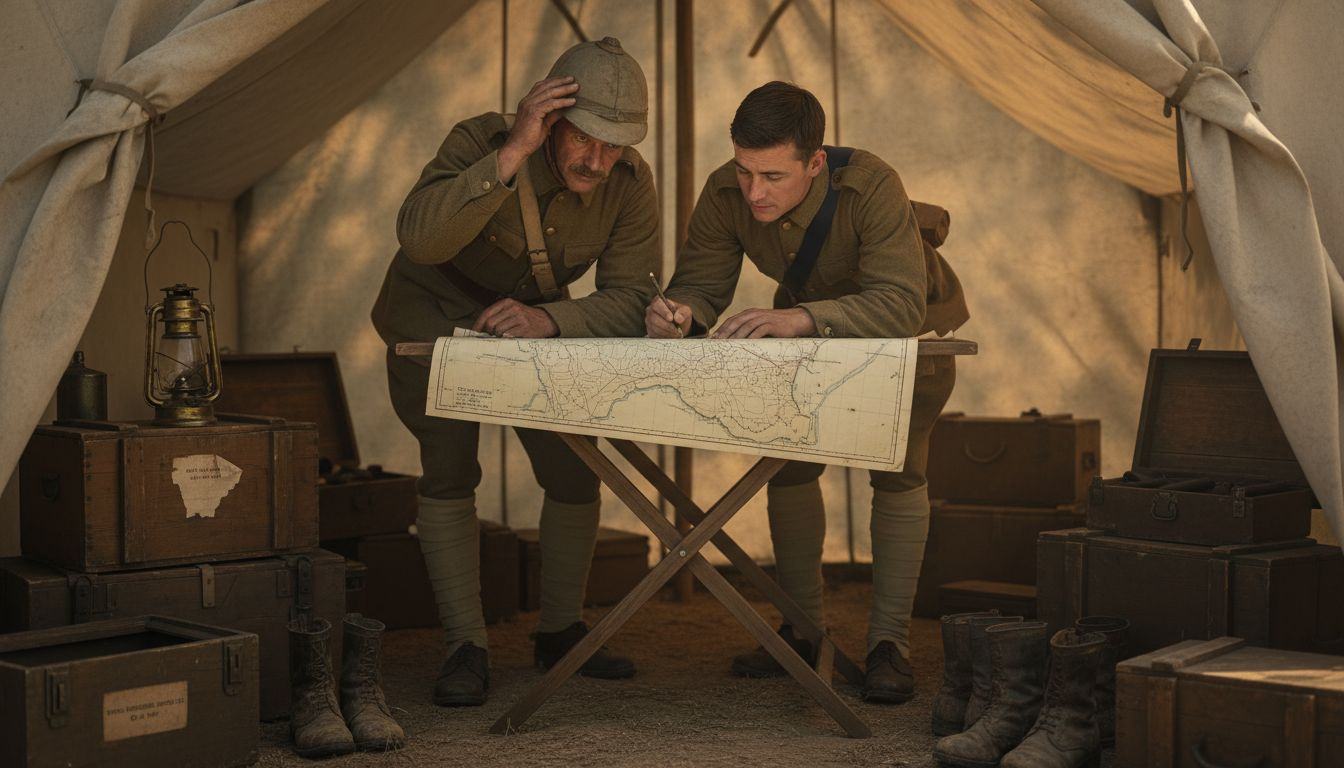
The scale of this transformation was staggering. The corps grew from just over 11,000 personnel in 1914 to nearly 300,000 by 1917. Think about that for a moment. Three hundred thousand engineers. That’s not a specialised unit anymore—that’s a significant portion of the entire British Expeditionary Force. Royal Engineers in the First World War handled railway and road maintenance, water supply management, communications, fortifications, and tunnel construction. They didn’t just build things; they built things under constant threat. They operated deep underground, tunnelling beneath enemy lines for mining operations. They pioneered countermeasures to chemical warfare when poisonous gas was first deployed. They maintained the vast logistical network that kept millions of soldiers supplied. Without the Royal Engineers operating on the Western Front, the British Army couldn’t have functioned.
The Second World War demanded yet another evolution. By this point, the corps had learned hard lessons about mobility, speed, and innovation. They expanded their focus to include airfield construction, recognising that air superiority required rapidly deployable bases that could be established, used, and sometimes abandoned as military situations demanded. Advanced bridging technologies emerged from their workshops—pontoon bridges, temporary spans, and rapid-crossing solutions that let armies move at speed instead of waiting for permanent structures. The corps operated in North Africa’s harsh desert conditions, constructed defences against German invasion on the British coast, and eventually supported the liberation of Europe. They weren’t just maintaining what was already there anymore; they were enabling rapid military manoeuvre on a continental scale.
What’s crucial to understand is that these weren’t separate functions—they built upon each other. The railway and road experience from colonial times informed how they managed vast supply chains in the trenches. The tunnel warfare expertise from the First World War translated into rapid fortification work in the Second. The chemical warfare countermeasures they pioneered continued to evolve. And the communications infrastructure they built in one war informed the next. The Royal Engineers transformed because warfare transformed, and they responded with practical innovation born from experience.
Pro tip: Document your specific engineering achievements from your service period, whether railway maintenance, bridge construction, or chemical defence work. These technical accomplishments are powerful narratives for commemorative recognition products that highlight your actual contribution to military operations rather than generic service descriptions.
Key Innovations and Specialist Capabilities
The Royal Engineers didn’t simply execute existing military engineering tasks. They invented entire disciplines. When you think of mine clearance operations today, you’re looking at techniques developed and refined by the Royal Engineers over generations. When explosive ordnance disposal teams work, they’re operating within a framework of knowledge that the corps pioneered. Mine clearance and bomb disposal represent two of the most dangerous specialisations in any modern military, yet the Royal Engineers took on these challenges and developed systematic approaches where none previously existed. These weren’t theoretical exercises conducted in safe environments. These were life-and-death innovations tested under fire, refined through hard experience, and passed on through rigorous training programmes that continue to this day.
Beyond explosive hazards, the corps developed an astonishing range of specialist capabilities. The Royal Engineers pioneered military use of telegraph and telecommunications, geospatial intelligence, amphibious operations, and deep and shallow water diving. What’s remarkable is how these specialisations support each other. You can’t conduct effective amphibious operations without understanding geospatial intelligence to identify landing zones. You can’t manage deep water operations without the technical knowledge developed through decades of construction in challenging environments. The corps evolved a diversified trades structure that includes electricians, carpenters, and specialists in countless other disciplines, all operating under the engineering banner but solving vastly different problems. A carpenter building field fortifications applies the same precision and understanding of materials as an electrician installing communications infrastructure, yet both operate in combat conditions that demand speed and adaptability.
The historical scope of Royal Engineers innovation extends far beyond military combat. Since the 18th century, the corps has tackled major civil infrastructure projects including dams, canals, and naval ports. They didn’t just design these projects; they executed them with military precision and rigour. This civil engineering background proved invaluable when wars required rapid construction of military infrastructure. A engineer who understands how to build a functioning canal understands water management, earthwork calculations, and logistics at a level that translates directly to establishing supply lines in forward areas. The corps even contributed to the development of military aviation, with their innovations laying groundwork for what eventually became the Royal Air Force. This wasn’t accidental—it reflected the corps’ culture of practical innovation and willingness to embrace new technologies.
What distinguishes the Royal Engineers from other engineering professions is that their innovations emerged from operational necessity rather than theoretical research. Field fortifications evolved because soldiers needed quick, effective defensive positions. Bridge construction developed specialised rapid-deployment techniques because armies needed to cross obstacles faster than enemy forces could destroy bridges. Parachute engineering emerged because the corps recognised that innovation in one area of warfare often demands innovation across multiple interconnected disciplines. Every specialised capability the corps developed answered a real problem encountered by real soldiers in real combat situations. That practical grounding in operational reality continues to define how the Royal Engineers approach problem-solving today, whether managing complex infrastructure projects or responding to humanitarian emergencies that demand the same rapid-response engineering capabilities developed through centuries of military service.
Pro tip: If you specialised in a particular engineering trade during your service—whether mine clearance, diving, parachute operations, telecommunications, or construction trades—highlight that specialisation in any recognition products or commemorative materials. These specific technical qualifications demonstrate expertise that extended far beyond typical military roles and showcase the breadth of professional capability within the Royal Engineers.
Traditions, Symbols, and Corps Identity
Walk into any Royal Engineers establishment and you’ll encounter symbols that carry centuries of meaning. The Corps Badge displays the Royal Arms flanked by the mottoes “Ubique” and “Quo Fas et Gloria Ducunt.” Ubique means “Everywhere,” a simple word that encapsulates the entire philosophy of the corps. It’s not simply a claim that Royal Engineers have been present at major military engagements. It reflects something deeper: a commitment to being wherever the British Army needed engineering expertise, whether that meant working in scorching deserts, freezing mountains, or the treacherous terrain of modern conflict zones. The motto isn’t decorative or ceremonial. It defines identity. When you wore that badge, you weren’t just identifying yourself as an engineer. You were declaring that you’d go anywhere, solve any problem, overcome any obstacle.
The nine-flamed grenade emblem stands as one of the most recognisable symbols in British military heraldry, and it carries weight earned through centuries of service. This emblem, combined with the Royal Arms, crown, and royal cypher featured in the cap badge, creates a visual language that speaks directly to those who understand military culture. The cap badge itself has been worn since the Boer War, making it not just a symbol but a living link to generations of Royal Engineers who served before you. These aren’t arbitrary design choices made by a branding committee. They were earned through action and refined through tradition. When you look at your cap badge, you’re looking at the distilled history of the corps. The grenade with nine flames represents something far more than ordnance. It represents the explosive force of engineering innovation applied to solve military problems.
Corp traditions extend beyond visual symbols into the lived experience of service. Wings, the Regimental March, plays at formal occasions, ceremonies, and gatherings where Royal Engineers come together. Music operates at a different level than badges or mottos. It carries emotional resonance that transcends time. When that march plays, serving and retired Royal Engineers respond at a visceral level because it connects them to everyone who ever wore the uniform. The corps chapel at Rochester Cathedral adds another layer to this identity structure. Bishop Gundulf, the patron saint and founding father figure, transforms the corps from a purely military institution into something with spiritual dimensions. Gundulf wasn’t just an engineer who happened to be a bishop. His life represented the practical application of knowledge and skill in service to a greater purpose. That’s what the Royal Engineers inherited and continue to embody. Understanding how badges function in military identity reveals how these physical symbols anchor abstract concepts like duty, continuity, and belonging into something personnel can actually wear and carry.
What’s crucial to grasp is that these traditions and symbols serve a real function beyond ceremonial observance. They create shared identity across generations and ranks. A young sappers working in the 2020s shares traditions with engineers from the 1950s, 1890s, and 1700s. That continuity matters. It provides context for present service and honours those who came before. The symbols aren’t dusty relics to be preserved in museums and forgotten. They’re living symbols that active personnel interact with daily. When you stand in formation wearing your uniform with the nine-flamed grenade and the royal cypher visible, you’re not just representing yourself. You’re representing everyone who ever served under those symbols. That’s not metaphorical. That’s the actual psychological and social function that military traditions serve.
Pro tip: When selecting commemorative recognition products featuring corps symbols, ensure the nine-flamed grenade, Corps motto, and royal cypher are accurately rendered, as these symbols carry profound meaning to Royal Engineers and immediate recognition among the wider military community. Products that incorporate these authentic symbols honour the actual identity and heritage of the corps far more effectively than generic military designs.
Modern Contributions and Lasting Legacy
The Royal Engineers of today operate in a fundamentally different world than their predecessors, yet the core mission remains unchanged: solve engineering problems that enable military operations. Modern conflicts aren’t fought on straightforward battlefields with clear front lines. They’re fought in urban environments, mountainous terrain, cyber space, and complex political landscapes where infrastructure itself becomes a strategic asset. The corps adapted. Today’s Royal Engineers conduct combat engineering that ranges from clearing improvised explosive devices in populated towns to constructing forward operating bases in remote regions. They manage infrastructure development projects that build lasting capacity in partner nations. They respond to humanitarian emergencies where engineering skills prove as vital as military expertise. When earthquakes devastate regions, when floods threaten communities, when disease outbreaks require rapid field hospital construction, Royal Engineers deploy with the same professionalism and technical competence they bring to military operations.
The modern Royal Engineers operate globally, delivering combat engineering, infrastructure construction, disaster relief, mapping, and geospatial intelligence. This isn’t a list of separate functions. These are interconnected capabilities that define modern military engineering. Mapping and geospatial intelligence seem like technical skills isolated from combat, but they’re absolutely central to modern operations. When forces need to understand terrain, identify optimal routes, assess infrastructure damage after conflict, or plan humanitarian responses, they rely on engineers who can translate complex geographical data into actionable intelligence. Mine clearance continues as one of the most critical and dangerous roles, particularly in regions where conflicts have ended but landmines remain, rendering vast tracts of land unusable for civilian purposes. The corps trains personnel in advanced amphibious operations that allow rapid deployment across water obstacles and into littoral zones where traditional approaches fail. These aren’t theoretical capabilities maintained for occasional use. They’re continuously refined through active operations across multiple continents.
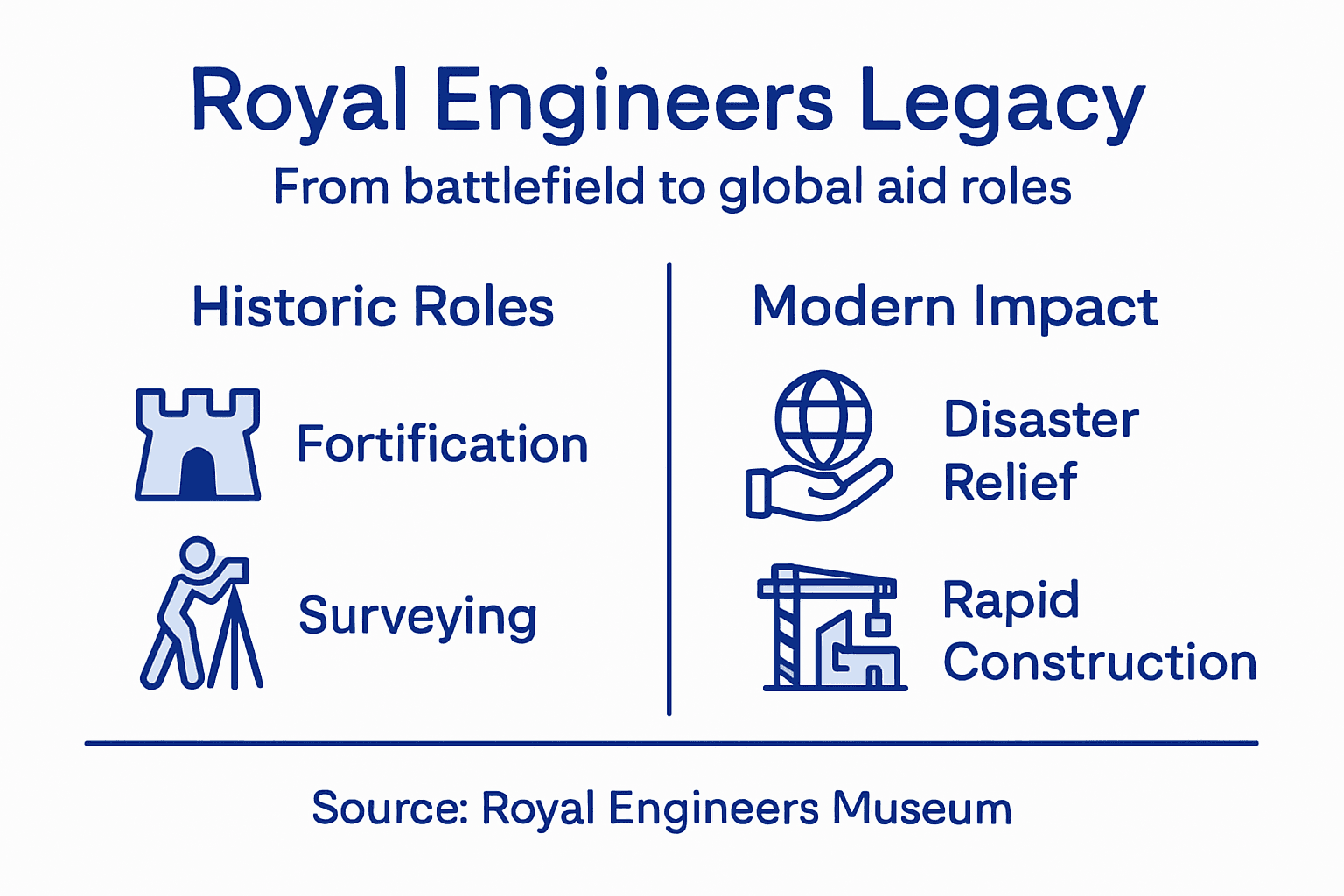
What distinguishes the modern Royal Engineers is their willingness to work across the boundary between military and civilian spheres. When COVID-19 overwhelmed hospital systems, Royal Engineers deployed to construct temporary medical facilities. When infrastructure in developing nations requires modernisation, the corps contributes expertise to sustainable projects. When post-conflict regions need rebuilding, Royal Engineers participate in long-term reconstruction efforts that establish relationships and build capacity. This flexibility reflects a historical truth: the Royal Engineers have always been problem-solvers willing to work wherever their skills were needed. The corps maintains its reputation as an elite and versatile institution precisely because it refuses to become narrow or specialised in ways that limit its utility. An engineer trained in bridge construction brings insights to field hospital design. An expert in water management contributes to disaster relief operations. A specialist in explosives ordnance disposal applies knowledge to infrastructure assessment and safety protocols.
This table outlines key modern specialisations of the Royal Engineers and their contributions:
| Specialisation | Core Function | Modern Contribution Example |
|---|---|---|
| Explosive Ordnance Disposal | Safe removal of explosives | Clears minefields in post-conflict zones |
| Geospatial Intelligence | Terrain analysis and mapping | Provides intelligence for operations |
| Amphibious Engineering | Rapid water crossings | Enables access to remote regions |
| Civil Infrastructure | Rebuilding and construction | Supports humanitarian disaster relief |
The lasting legacy of the Royal Engineers isn’t measured in monuments or commemorative plaques, though those certainly exist. It’s measured in the ongoing capability of the British Army to operate effectively across every environment and every type of challenge. It’s measured in the infrastructure that exists in partner nations because Royal Engineers built it. It’s measured in lives saved because trained personnel knew how to clear mines, dispose of explosives, or construct medical facilities under pressure. The corps continues to innovate because warfare continues to evolve, and the Royal Engineers remain committed to staying ahead of emerging challenges. Whether that means mastering new technologies, adapting to climate-related infrastructure challenges, or developing capabilities for conflicts that haven’t yet been imagined, the corps approaches these challenges with the same practical determination that has defined it since William the Conqueror brought the first military engineers to England nearly 1,000 years ago. That continuity of purpose, combined with genuine adaptability, represents the most important legacy the Royal Engineers can pass forward.
Pro tip: When creating commemorative materials honouring Royal Engineers service, emphasise the versatility and adaptability demonstrated across centuries of changing military and humanitarian challenges. Stories highlighting specific infrastructure projects, disaster relief contributions, or innovative engineering solutions resonate far more powerfully than generic military service descriptions, as they reflect the genuine breadth of what the corps actually accomplishes.
Celebrate the Enduring Legacy of the Royal Engineers with Personalised Gifts
The Royal Engineers have demonstrated unparalleled versatility and dedication through centuries of military innovation and service. Their commitment to solving complex engineering challenges “Everywhere” has created a powerful tradition that deserves honouring. Whether you are recognising a veteran’s expert skills in mine clearance or commemorating the corps’ historic contributions from the Norman invasion to modern humanitarian missions, the right keepsake helps preserve these remarkable stories.
Explore our wide range of The Corps of Royal Engineers, Leaving Gifts and Personalised Presentations at The Regimental Store. Each item is designed to reflect authentic corps symbols like the nine-flamed grenade and Corps motto, deepening the connection to this proud heritage. Act now to secure meaningful, expertly crafted keepsakes that embody the spirit of determination and innovation spanning nearly a millennium. Discover more about commemorating all branches on our Home page or browse the full Regimental Store for the perfect tribute.
Frequently Asked Questions
What is the historical significance of the Royal Engineers?
The Royal Engineers have a rich history dating back to 1066, initially providing military engineering services and evolving through significant historical events such as the formation in 1716 and their crucial roles in both World Wars. Their expertise has been fundamental to British military campaigns for nearly a millennium.
How did the Royal Engineers adapt during the First World War?
During the First World War, the Royal Engineers expanded their roles significantly, moving from colonial engineering tasks to combat engineering. They tackled challenges such as trench maintenance, tunnel construction, and developed new methods to respond to threats like chemical warfare, growing their ranks from 11,000 personnel to nearly 300,000 by 1917.
What innovations have the Royal Engineers contributed to modern military operations?
The Royal Engineers have pioneered numerous innovations, including mine clearance and bomb disposal techniques, techniques for amphibious operations, and advancements in geospatial intelligence. Their contributions enable efficient responses to modern military challenges and humanitarian emergencies.
How do traditions and symbols shape the identity of the Royal Engineers?
Traditions and symbols, such as the Corps Badge and emblem, foster a shared identity among Royal Engineers across generations. These elements reflect the corps’ values and commitment to service, creating a sense of belonging and continuity within the military community.
Recommended
- Royal Artillery: Why It Matters for UK Defence – The Regimental Store Ltd
- Royal Signals: Heritage and Impact in the British Army – The Regimental Store Ltd
- History of the Royal Marines – Why It Matters for Veterans – The Regimental Store Ltd
- Royal Regiment of Scotland: Legacy and Modern Impact – The Regimental Store Ltd