
Remembrance Poppy: Meaning for British Veterans
Every poppy pinned to a lapel around Remembrance Day holds a story of sacrifice and unity familiar to British veterans and serving personnel. The tradition began in the aftermath of the First World War when red poppies flourished on battlefields, inspiring the iconic poem ‘In Flanders Fields’. The Remembrance poppy has become a powerful emblem of respect and hope, yet several myths persist about its meaning. This guide clarifies the true symbolism of the poppy and its role within the Armed Forces community.
Table of Contents
- Remembrance Poppy—Definition And Common Myths
- History And Origins Of The Poppy Symbol
- Different Colours And Types Of Poppies
- Guidance On Wearing The Poppy Correctly
- The Poppy’s Role For Veterans And Serving Personnel
Key Takeaways
| Point | Details |
|---|---|
| Symbol of Remembrance | The Remembrance poppy honours the sacrifice of military personnel, encapsulating respect, remembrance, and gratitude, rather than glorification of conflict. |
| Personal Choice | Wearing a poppy is a personal decision reflecting individual respect for those who served, not an obligation or political statement. |
| Diverse Symbolism | Different coloured poppies signify various aspects of remembrance, including peace and recognition of minority contributions, enriching the narrative of commemoration. |
| Emotional and Social Impact | The poppy provides emotional support to veterans and serves as a unifying symbol for the general public, fostering a sense of community and shared gratitude. |
Remembrance poppy—definition and common myths
The Remembrance poppy represents far more than a simple flower pin. This symbolic emblem commemorates the profound sacrifice of British military personnel who have served their country, particularly those who lost their lives during wartime conflicts. British military heritage reveals a powerful tradition deeply rooted in historical significance and emotional resonance.
Originating from the tragic battlefields of the First World War, the poppy emerged as a poignant symbol inspired by the haunting poem ‘In Flanders Fields’. The flower’s natural red colour represents the blood shed by soldiers and serves as a powerful metaphor for remembrance and hope. Despite popular misconceptions, the poppy carries nuanced meanings beyond simple memorialisation:
- Not a political statement: Contrary to some myths, wearing a poppy is not an endorsement of war
- Personal choice: Individuals choose to wear the poppy as a mark of respect, not obligation
- Universal commemoration: Represents remembrance for all military personnel, regardless of conflict or era
The poppy symbolises respect, remembrance, and gratitude—not glorification of conflict.
Several persistent myths surrounding the Remembrance poppy require clarification. Many incorrectly assume that wearing a poppy supports specific political views or militaristic perspectives. In reality, the poppy represents a deeply personal act of honouring those who served and sacrificed. It transcends political divisions, serving as a unifying symbol of national gratitude.
Pro tip: When wearing your poppy, remember it represents individual stories of courage, sacrifice, and human resilience—not abstract political narratives.
History and origins of the poppy symbol
The Remembrance poppy emerged from the profound devastation of the First World War, transforming from a simple wildflower into a powerful symbol of sacrifice and memory. First World War battlefields witnessed an extraordinary phenomenon where delicate red poppies flourished amid landscapes torn apart by conflict, creating a poignant metaphor of hope and resilience.
The story begins with Lieutenant Colonel John McCrae, a Canadian physician who penned the iconic poem ‘In Flanders Fields’ after witnessing the brutal realities of war. His verses immortalised the red poppies growing amidst soldiers’ graves, capturing the tragic beauty of renewal and remembrance. Key moments in the poppy’s historical journey include:
- 1915: John McCrae writes ‘In Flanders Fields’ following the death of his friend
- 1918: End of the First World War sparks remembrance movements
- 1921: Royal British Legion officially adopts the poppy as a remembrance symbol
- 1922: First Poppy Appeal fundraising campaign launches in the United Kingdom
The poppy represents life emerging from devastation, a testament to human resilience and hope.
The transformation from a local symbol to a national commemoration was driven by remarkable individuals. American professor Moina Michael was profoundly moved by McCrae’s poem and began campaigning to make the poppy an official remembrance emblem. Her passionate advocacy spread internationally, ultimately leading the Royal British Legion to formally adopt the poppy as a fundraising and commemorative symbol in 1921.
Pro tip: When wearing your poppy, remember you’re carrying a piece of living history that represents collective memory and individual sacrifice.
Different colours and types of poppies
The Remembrance poppy is far more than a single, uniform symbol. Poppy variations reflect nuanced commemorative traditions across the United Kingdom, each design carrying its own historical significance and regional identity. While the traditional red poppy remains the most recognised, subtle yet meaningful differences exist in both design and symbolism.
The classic red poppy, inspired by the field poppies of Flanders, represents the primary remembrance symbol. However, regional variations demonstrate the complexity of commemoration:
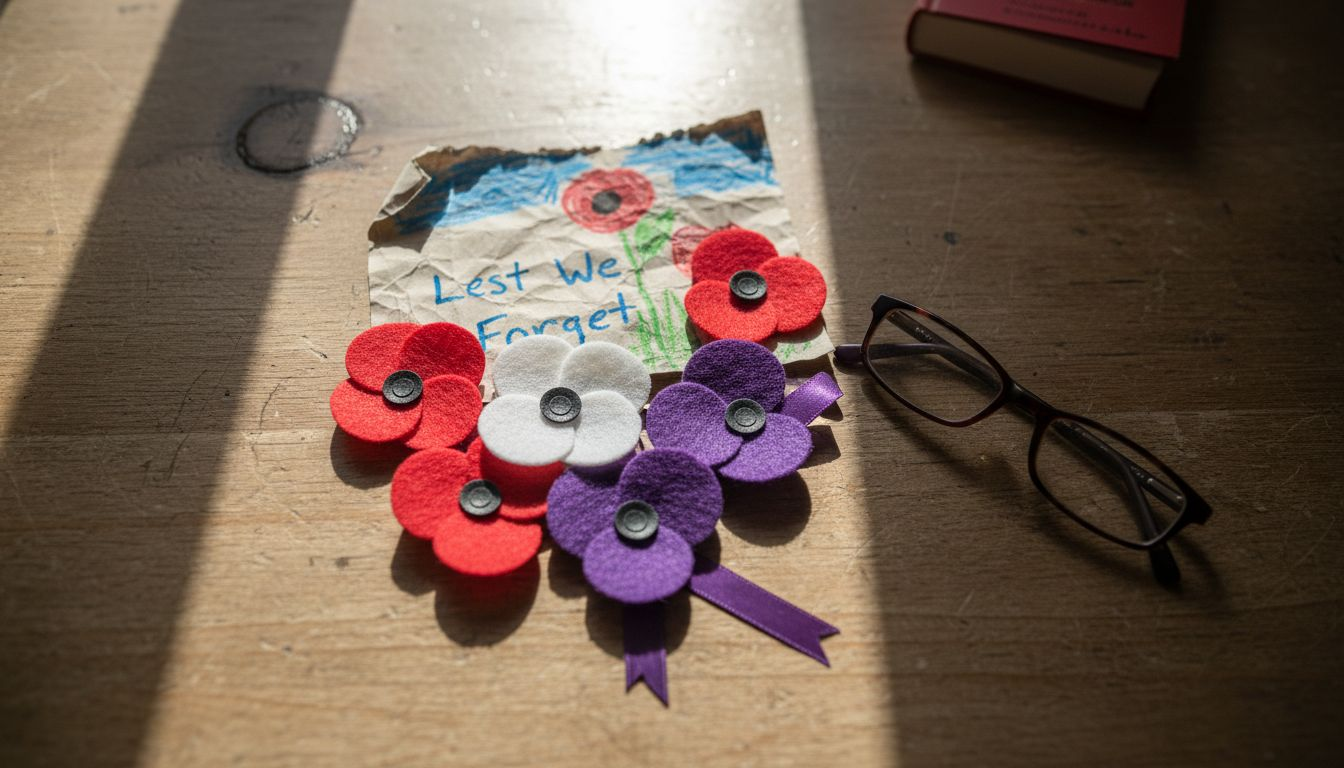
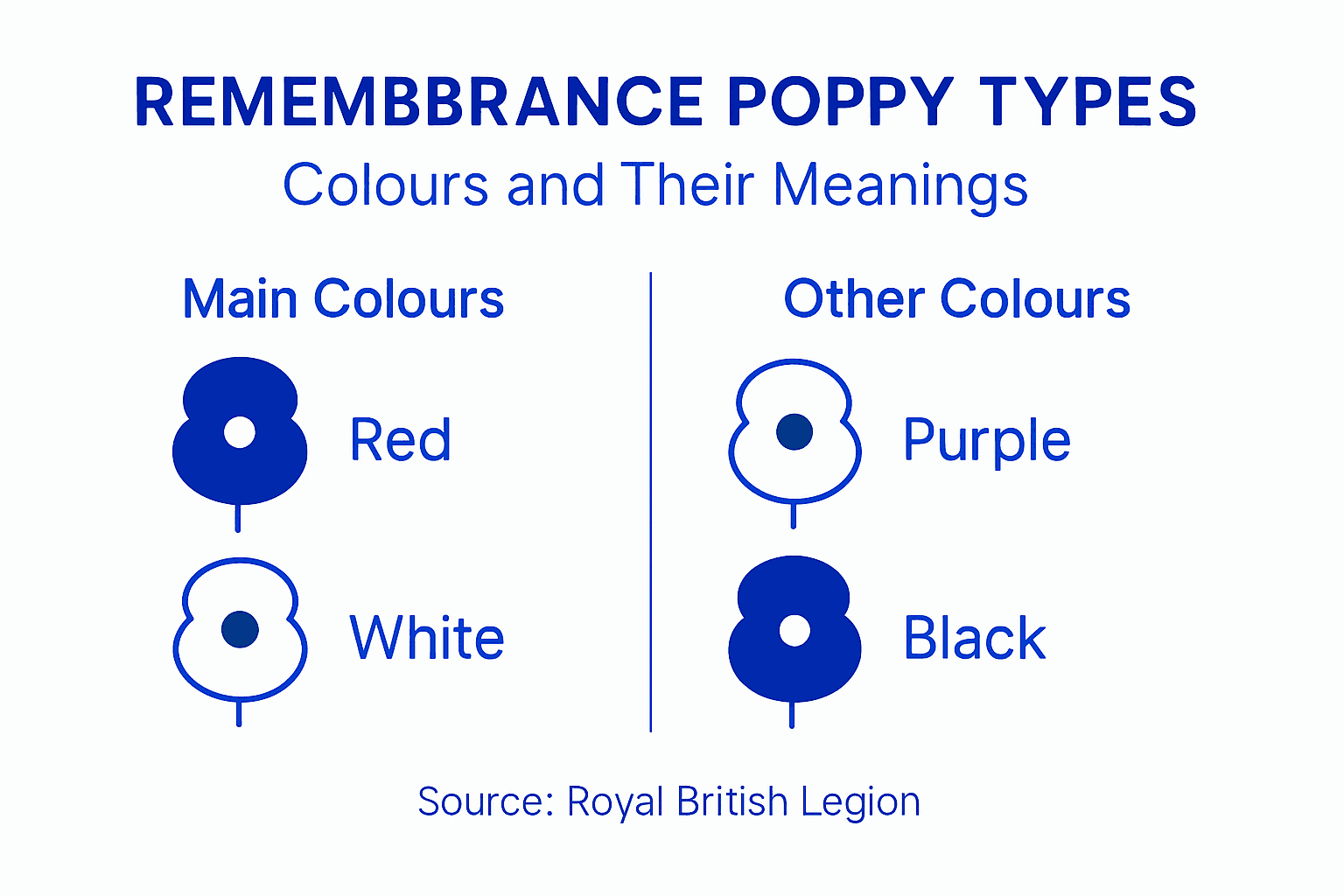
Here is a summary of the different commemorative poppy types and their unique meanings:
| Poppy Colour | Main Symbolism | Key Group Represented |
|---|---|---|
| Red | Sacrifice and remembrance | All British and Commonwealth military personnel |
| White | Peace and anti-war sentiment | Supporters of pacifist remembrance |
| Purple | Honouring animal contributions | Victims and animals in war |
| Black | Recognising Black and minority service | African, Caribbean, and Black veterans |
| Scottish (Red, Four-Petal) | Scottish regional tradition | Scottish fallen soldiers and veterans |
- Traditional Red Poppy: Standard two-petal design with a green leaf
- Scottish Poppy: Distinctive four-petal design, unique to Scottish remembrance
- White Poppy: Symbolises peace and opposition to war
- Purple Poppy: Commemorates animal victims of conflict
- Black Poppy: Represents contributions of African, Caribbean, and Black servicemen and women
Each poppy colour tells a unique story of remembrance, sacrifice, and historical understanding.
The evolution of poppy design reflects changing historical perspectives. The green leaf, for instance, was introduced in the 1960s and became a standard feature in the 1990s, symbolising growth and renewal alongside remembrance. These subtle design modifications demonstrate how commemoration practices continuously adapt to reflect broader societal understanding of military service and sacrifice.
Pro tip: Choose your poppy thoughtfully, understanding that each colour represents a different aspect of remembrance and honour.
Guidance on wearing the poppy correctly
Wearing a Remembrance poppy is a deeply personal act of commemoration, with flexible etiquette guidelines that honour individual expression while maintaining traditional respect. The subtle nuances of poppy placement reflect both personal choice and historical significance.
While there is no strictly mandated ‘correct’ way to wear a poppy, several traditional practices have emerged over the years. Most veterans and civilians follow these general guidelines:
- Position: Typically worn on the left side, closer to the heart
- Gender variations: Men often wear it on the left lapel, women sometimes on the right like a brooch
- Leaf orientation: Can point towards 11 o’clock, symbolising the armistice hour (optional)
- Timing: Usually worn from late October to 11 November (Remembrance Day)
- Condition: Wear a fresh, intact poppy as a sign of respect
Wearing a poppy is a personal choice that symbolises remembrance, not a mandatory obligation.
The Royal British Legion emphasises that poppy wearing should be an act of genuine reflection and gratitude. The positioning and style are less important than the underlying sentiment of honouring those who have served. Veterans and civilians alike are encouraged to wear the poppy with pride, understanding its deeper meaning beyond mere physical placement.
Pro tip: Choose how you wear your poppy based on personal comfort and meaning, remembering that respect matters more than strict adherence to rules.
The poppy’s role for veterans and serving personnel
For veterans and serving military personnel, the Remembrance poppy transcends a simple commemorative symbol, representing a profound connection to collective memory, individual sacrifice, and shared experience. Military service heritage embodies a deep emotional landscape where remembrance becomes a bridge between past and present generations of service members.
The poppy serves multiple critical functions for those who have served or are currently serving in the Armed Forces:
- Emotional Support: Provides a tangible mechanism for processing grief and commemorating fallen comrades
- Community Connection: Creates a sense of solidarity among veterans across different service periods
- Intergenerational Understanding: Helps younger generations appreciate military service sacrifices
- Healing Mechanism: Offers a symbolic pathway for acknowledging complex military experiences
- Collective Memory: Maintains a continuous narrative of military service and national resilience
The poppy is more than a symbol—it is a living testimony of military service, sacrifice, and shared brotherhood.
Beyond its commemorative function, the poppy represents a nuanced form of psychological healing for many veterans. It provides a socially acceptable method of expressing grief, remembrance, and complex emotions associated with military service. For serving personnel, it reinforces the unbroken chain of service that connects current military members with those who came before them, creating a powerful sense of continuity and shared purpose.
The table below contrasts the impacts of the Remembrance poppy on different groups:
| Group | Emotional Impact | Social Impact |
|---|---|---|
| Veterans | Offers healing and solidarity | Reinforces shared identity |
| Serving Personnel | Connects with heritage | Supports national recognition |
| General Public | Promotes reflection | Fosters unity and gratitude |
Pro tip: Wear your poppy not just as a symbol, but as a personal tribute to the shared experiences and sacrifices that define military service.
Honour the Sacrifice with Meaningful Gifts for British Veterans
The profound significance of the Remembrance Poppy lies in its role as a symbol of respect, healing, and collective memory for British veterans and serving personnel. Many face the challenge of finding ways to express gratitude and solidarity that truly reflect the depth of their sacrifice and shared experience. Whether you seek a thoughtful gift or a personalised presentation award, our selection offers meaningful options that embody these values.
Explore The REME Shop for gifts and personalised presentaion awards to find treasures that resonate with the stories of courage and remembrance. Visit our Royal Highland Fusiliers Museum Shop for unique memorabilia that honours military heritage. Act today to select a tribute that strengthens bonds and commemorates sacrifice with pride. Browse now at https://regimentalstore.co.uk to discover how you can make remembrance deeply personal.
Frequently Asked Questions
What does the Remembrance poppy symbolise for British veterans?
The Remembrance poppy symbolises respect, remembrance, and gratitude for all British military personnel who have served and sacrificed, particularly those who lost their lives in conflict.
When is the appropriate time to wear a Remembrance poppy?
The Remembrance poppy is usually worn from late October until 11 November, which is Remembrance Day, to honour and commemorate those who served.
What are the different types of poppies and their meanings?
The common types include the red poppy, which commemorates all military personnel; the white poppy, symbolising peace; the purple poppy for animal victims; and the black poppy, recognising the contributions of Black servicemen and women.
How should I wear a Remembrance poppy?
Traditionally, the poppy is worn on the left side, closer to the heart. Men typically place it on their left lapel, while women may wear it on their right side like a brooch. The leaf can point towards 11 o’clock to symbolise the armistice hour, although this is optional.
Recommended
- Complete Guide to the Meaning of Veteran Memorabilia – The Regimental Store Ltd
- Purpose of Veteran Reunion Gifts – Honouring Shared Service – The Regimental Store Ltd
- How to Gift for Veterans: Honouring British Service – The Regimental Store Ltd
- What Is a Commemorative Plaque for UK Veterans – The Regimental Store Ltd